

- Vimal
- 0 Comments
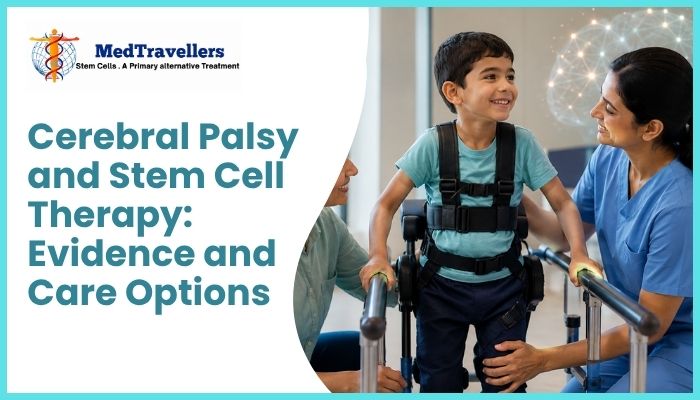
Cerebral Palsy and Stem Cell Therapy: Evidence and Care Options
Cerebral palsy (CP) is a group of conditions that affect movement and posture and can lead to limitations in daily activities. Because every child can experience cerebral palsy differently, treatment and care are generally based on individual needs.
For families exploring new treatment approaches, stem cell therapy for cerebral palsy India is an area of clinical research. However, it is important to understand the difference between investigational treatments and established cerebral palsy care.
What Is Cerebral Palsy?
Cerebral palsy results from abnormal development or injury to the developing brain and can affect movement and posture. Children may also experience associated difficulties involving communication, sensation, cognition, epilepsy, or musculoskeletal health.
The effects can vary significantly from one child to another. This means there is no single treatment that is appropriate for every child with cerebral palsy.
Care may involve several healthcare professionals depending on the child’s individual requirements.
What Is Stem Cell Therapy for Cerebral Palsy?
Stem cell therapy is being investigated as a possible treatment approach for cerebral palsy.
Clinical research has examined different types of cells, sources, doses, and methods of administration. These differences are important because evidence for one treatment approach cannot automatically be applied to another.
For families considering stem cell therapy for cerebral palsy India, it is therefore important to understand the specific treatment being proposed and the evidence supporting it.
What Does the Paediatric Stem Cell Guideline Say?
The 2026 evidence-based guideline from the Department of Health Research (DHR), Government of India, provides important guidance on stem cell therapy for cerebral palsy.
The guideline states that stem cell therapy is not recommended in routine clinical practice for the treatment of cerebral palsy.
It gives a conditional recommendation with very low certainty of evidence and states that stem cell therapy may be used only in the context of rigorously conducted randomized controlled trials.
This is an important distinction for families. The availability of a stem cell treatment does not mean that it has been established as a routine treatment for cerebral palsy.
What Does Current Evidence Mean for Families?
The DHR guideline’s recommendation reflects the current uncertainty surrounding stem cell therapy for cerebral palsy.
Families should therefore avoid assuming that a stem cell treatment will produce a particular outcome or replace established care.
Before considering treatment, parents should understand what is being proposed, why it is being considered, what evidence supports the approach, and what potential risks and limitations have been discussed by the treating medical team.
What Are Clinical Trials?
Clinical trials are an important way of evaluating medical treatments.
For stem cell therapy, clinical trials can investigate different treatment protocols and assess outcomes and safety under defined research conditions.
Families should ask whether a proposed stem cell treatment is part of a properly conducted clinical trial. They should also request clear information about the study, its objectives, eligibility requirements, potential risks, and follow-up.
A treatment offered commercially should not automatically be considered equivalent to a treatment being investigated through a controlled clinical trial.
Why Is CP Rehabilitation Important?
CP rehabilitation remains an important part of cerebral palsy care.
Depending on the child’s needs, rehabilitation may address movement, communication, feeding, mobility, musculoskeletal health, and other functional challenges.
Care may involve different healthcare professionals depending on the child’s individual requirements.
Because the DHR guideline does not recommend stem cell therapy for routine clinical treatment of cerebral palsy, families should not view stem cell therapy as a replacement for established rehabilitation and supportive care.
Can Stem Cell Therapy Replace CP Rehabilitation?
Current guidance does not support presenting stem cell therapy as a replacement for CP rehabilitation.
Children with cerebral palsy may require ongoing rehabilitation and monitoring according to their individual needs.
If a family is considering stem cell therapy within a clinical research setting, the treating team should explain how the intervention fits into the child’s overall care plan.
Parents should also discuss established treatment and rehabilitation options with qualified specialists rather than stopping existing care based on expectations about an investigational treatment.
What Should Parents Ask Before Treatment?
Families considering stem cell therapy for cerebral palsy India should obtain detailed information before making a treatment decision.
Important questions include:
- What type of cells are being used?
- Where are the cells obtained from?
- How are they processed?
- What is the proposed treatment protocol?
- What evidence supports this specific approach?
- Is it part of a registered clinical trial?
- What are the potential risks?
- How will treatment outcomes be assessed?
- What follow-up is required?
- What rehabilitation and other care will continue?
These questions can help parents understand the nature of the proposed treatment and make a more informed decision.
What Should International Families Know?
Families travelling to India to explore stem cell therapy for cerebral palsy India should first understand the medical evidence and the proposed treatment.
Before making travel arrangements, they should request information about the treating specialists, treatment protocol, evidence supporting the approach, potential risks, follow-up requirements, and costs.
Families should also clarify whether the proposed intervention is being provided as part of a clinical trial.
Travel and logistical arrangements should come after the family has sufficient medical information to make an informed decision.
How MedTravellers Supports Patients Exploring Stem Cell Therapy
MedTravellers focuses on stem cell therapy and regenerative medicine, supporting patients and families exploring stem cell treatment options in India.
For families considering treatment for cerebral palsy, MedTravellers can help coordinate the consultation and treatment-planning process and assist with practical arrangements related to the patient’s treatment journey.
For international families, this support may include coordination related to medical consultations, travel, accommodation, hospital visits, and follow-up.
The suitability of any treatment should be determined by qualified medical specialists based on the child’s individual condition and the available clinical evidence.
What Does the Future Hold?
Stem cell therapy for cerebral palsy remains an area of clinical investigation.
The 2026 DHR guideline’s recommendation reflects the current uncertainty around its routine clinical use. Further rigorously conducted randomized controlled trials are needed before stem cell therapy can be considered an established routine treatment for cerebral palsy.
Until stronger evidence becomes available, families should distinguish between clinical research and established cerebral palsy care.
In Conclusion
Stem cell therapy for cerebral palsy India remains an area of clinical research rather than an established routine treatment.
The 2026 DHR guideline states that stem cell therapy is not recommended in routine clinical practice for cerebral palsy, with a conditional recommendation and very low certainty of evidence. It states that the therapy may be used only within rigorously conducted randomized controlled trials.
For families, CP rehabilitation and appropriate supportive care remain important components of the overall care plan. Parents considering stem cell therapy should discuss the available evidence, potential risks, alternatives, and clinical-trial status with qualified specialists before making a treatment decision.
MedTravellers focuses on stem cell therapy and regenerative medicine and can support families exploring stem cell treatment options by coordinating the consultation and treatment-planning process. Medical decisions remain with the qualified treating team.
Disclaimer: This article is for educational purposes only and is not medical advice. Stem cell therapy for cerebral palsy remains an evolving area of research and is not recommended for routine clinical practice by the 2026 DHR guideline. Families should consult qualified medical specialists before making treatment decisions.