Advanced Stem Cell Treatment for Leukemia in India with Trusted Care and Better Outcomes

Quick Summary

What it is
a bone marrow / stem cell transplant that restores healthy blood and immune cells.

Who it helps
patients with acute and chronic leukaemias, decided case by case by a haematologist.

Why India
treatment costs roughly 50–70% less than in Western countries, at hospitals with dedicated transplant units.

Cost
broadly USD 18,000–45,000, depending on the transplant type and donor situation.

At MedTravellers
our team handles your leukaemia treatment from the first review through the transplant and recovery, with full support for international patients along the way.
Stem Cell Treatment for Leukaemia in India
A leukaemia diagnosis moves fast, and the decisions around it move just as fast. When a haematologist says a stem cell transplant is the next step, a family is suddenly weighing hard questions.
Where do we go. Can we afford it. Is it safe to travel for something this serious.
If you’re reading this from outside India, those questions weigh even heavier. You’re not only choosing a treatment. You’re choosing a country, a team, and a place to be unwell, a long way from home.
This is where MedTravellers comes in. We’re a dedicated stem cell treatment centre in New Delhi, and leukaemia is one of the conditions we treat. From the first look at your reports to the transplant itself and the recovery that follows, your care stays with one team that owns the outcome.
It starts with your reports. Our specialists review the diagnosis, the blood counts, and the marrow findings, then give you an honest read on whether a transplant fits and which type would suit. If a transplant isn’t right for your case, we’ll tell you that on prior.
Once the treatment plan is set, everything runs from here. The treatment protocol built around your leukaemia type and stage along with treatment cost estimate.
For a clinical opinion on your case, share your medical reports with our specialists. Request a confidential case review.
Which Types of Leukaemia Can Be Treated at MedTravellers
Stem cell transplants are used across the main leukaemia types, including acute myeloid leukaemia (AML), acute lymphoblastic leukaemia (ALL), chronic myeloid leukaemia (CML), and chronic lymphocytic leukaemia (CLL). The call depends on your diagnosis, the stage, your genetic markers, and how the disease has responded to treatment so far. Our haematologists reviews all of that before recommending anything..
How the Treatment Works
Treatment follows a clear, staged path.
1. Evaluation.
A haematologist reviews medical records, blood and marrow tests, and overall fitness to confirm whether a transplant is suitable.
2. Donor matching.
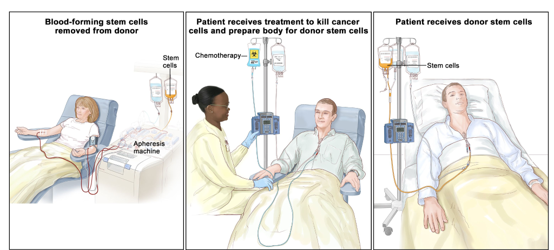
For an allogeneic transplant, family members are tested first, with unrelated-donor and cord-blood registries searched if needed.
3. Conditioning.
Chemotherapy, sometimes with radiation, clears the diseased marrow and prepares the body to receive new cells.
4. Stem cell infusion.
Healthy stem cells are given through a drip, much like a blood transfusion.
5. Engraftment and recovery.
Over the following weeks, the new cells settle in the marrow and begin producing healthy blood. Patients are monitored closely in a protected transplant unit.
6. Follow-up.
Recovery and immune rebuilding continue for months. Regular monitoring continues after the patient returns home.
Types of Stem Cell Transplant for Leukaemia
A haematologist decides the right type based on the leukaemia subtype, the patient’s age and health, and whether a matched donor is available.
Autologous transplant.
Uses the patient's own stem cells, collected and stored before high-dose treatment. Lower risk of rejection, though less commonly used for leukaemia than for some other blood cancers.
Allogeneic transplant.
Uses stem cells from a donor — a matched sibling, a matched unrelated donor, or a half-matched (haploidentical) family member. This is the standard approach for many leukaemias, because donor cells also help fight remaining cancer cells.
Umbilical cord blood transplant.
Uses stem cells from donated cord blood, an option when a closely matched adult donor is not available.
Our team can review your reports and advise on suitability, transplant type, and expected timelines. Schedule a specialist consultation.
Why Choose MedTravellers for Leukaemia Stem Cell Treatment in India?
We’re a stem cell treatment centre in New Delhi, and if you’re coming from abroad, our team carries you the whole way, not just the medical part.
- Specialist review: Our transplant specialists go through your reports before any treatment is confirmed.
- A plan built for you: Your protocol is matched to your leukaemia type, stage, and donor situation.
- Transparent estimates: You get a clear, itemised cost estimate, with no surprises waiting after you arrive.
- Quality care with affordable cost: A transplant in India usually costs 50% to 70% less than the same care in the West, and accredited centres still hold to international clinical standards.
- Travel and visa support: Medical visa guidance, airport pickup, and somewhere to stay near the hospital for you and a companion.
- Care through treatment: A coordinator stays reachable for the whole stay, with an interpreter on hand if you need one.
- Follow-up at home: We help sort out reports and teleconsultations so your local doctor stays in the loop.
Cost of Stem Cell Treatment for Leukaemia in India
What you pay depends on the transplant type, the donor situation, the hospital, and how long you stay. An autologous transplant tends to start lower. An allogeneic (donor) transplant runs higher, because of donor testing and a longer course of treatment. As a broad guide, leukaemia stem cell transplants in India sit in the USD 18,000 to 45,000 range.
For context, a bone marrow transplant in India runs roughly USD 20,000 to 63,000, against around USD 200,000 in the US. Every case is different, so at MedTravellers once a transplant specialist has reviewed your reports, you get an itemised estimate.
Success Rates and Realistic Expectations
Outcomes vary depending on the leukaemia type, your age and general health, how advanced the disease is at transplant, and how good the donor match is. The CIBMTR, the world's largest transplant outcomes registry, reports around 80.5% three-year survival for paediatric acute lymphoblastic leukaemia (ALL) when an allogeneic transplant is done in first complete remission. Results drop when transplant happens later. For adult acute myeloid leukaemia (AML), a 2025 peer-reviewed review puts two-year survival at around 62% after a matched-sibling transplant, and about 58% at five years for patients transplanted in complete remission. A paediatric transplant series from AIIMS New Delhi describes survival comparable to that of well-resourced Western units. These are population averages, not a guarantee. A transplant is major treatment, with real risks including infection and graft-versus-host disease.
Frequently Asked Questions
Is a stem cell transplant a cure for leukaemia?
For some patients it’s the best shot at long-term remission. But outcomes depend on the leukaemia type, age, stage, and donor match, so only a haematologist can speak to your case.
What's the difference between a bone marrow transplant and a stem cell transplant?
They’re basically the same treatment. The difference is just where the cells come from: bone marrow, circulating blood, or umbilical cord blood.
How long will I need to stay in India?
Usually several weeks in hospital, plus a recovery period nearby. Your estimate will spell out the expected timeline.
Do I need a donor?
Depends on the transplant type. Allogeneic transplants need a matched donor. Autologous transplants use your own cells. Your specialist will tell you which applies.
Can MedTravellers help with the medical visa?
Yes. We provide a hospital invitation letter and guidance to support your medical visa application.